Friday, May 4, 2012
LEED Gold - Yukon's First LEED Canada Certified Homes
Well, after a year of waiting, we finally got our LEED® Canada for Homes Certification for the SuperGreen Duplex we built at 38 & 40 Nijmegan Road. As we talked about before, this is the first LEED® Certified home in the Yukon, and the second LEED® certified building in the Yukon (the first was the Taku Building on Main Street, and I think they beat us by only a couple of weeks!). If nothing else, I can say that the process was thorough, taking almost longer to complete the certification that it did for us to build the homes! Pretty much every suststainability claim we made was verified by the Provider before submission to Canada Green Building Council. And I think because this was a Yukon first, they were extra diligent.
Anyway, if felt good to finally screw the LEED® plaques to the building, knowing that we've raised the bar, but at the same time made some high quality affordable housing, and most of all, that the owners/tenants of the SuperGreen duplex seem to be very happy and satisfied with their homes that will last generations.
Labels:
Buildings,
Energy Efficiency,
LEED,
Sustainable Building
Monday, April 16, 2012
One Year in a SuperGreen Home
We've now got a whole year's worth of energy usage data from the SuperGreen duplex. And the results confirm what the earlier trends showed - this home is using even less energy than predicted, about 30% less!
Results are shown for 38 Nijmegan below (special thanks to the owners for sharing the energy usage data). We also have almost a full year from 40 Nijmegan, the other half of the duplex. And it shows the same trends - about 30% less energy usage. So this tells us it is not just a fluke or entirely occupant behaviour--in fact the buildings are performing consistently better and anticipated.
The graphs below shows predicted energy usage (shown as bars) versus the actual total energy usage in the duplex (shown as a green line) for the months for a whole year. The red line show is the energy usage of a similarly sized conventional new home in Whitehorse. Actually energy usage has been "normalized" to take of the fact that much of this year's winter was pretty warm. So this is adjusted to average weather conditions.
SuperGreen Energy Usage Versus a Conventional Home
For comparison purposes (and to help illustrated the predicted versus actual energy performance of the building) the energy usage of a similarly sized, new home in Whitehorse is shown on the graph as the red line. This represents an electrically heated new home built in compliance with the City of Whitehorse’s energy efficiency bylaw. By way of comparison, over the year, total energy costs for the conventional, electrically home would have been $3,920. The actual energy costs over the same period for the SuperGreen duplex have only been $1,390. That is less than half the energy cost – a savings of $2,530 in just one year!
Labels:
Energy Efficiency,
Energy Security,
LEED,
Sustainable Building
Sunday, April 1, 2012
Yukon's Reservoir Levels - April Update
I've been skipping a bit of winter and haven't done an energy battery update in sometime - but this is the time we really draw down our stored renewable energy, and things get lean in the spring.
Marsh Lake is looking quite low, about 2/3 of what we normally have at this time of year, but Mayo and Aishihik lakes are fuller than average; overall we aren't too far below how much water we normally have at this time of year. Right now the overall energy stored is down to 33%, about 2% lower than average for this time of year. Probably the warm February and March this year kept demand down even though we're a growing community.
Let's hope for a quick, warm spring!
Saturday, February 18, 2012
Epic run over three volcanos
I get bored really easily and so for my long runs I'm always trying to think of new adventures to go on. Here in Portland, there are multiple extinct volcanos within the City, so I figured out a route to run up and over three of them: Rocky Butte, Mt. Tabor and Kelly Butte.
Saturday, January 21, 2012
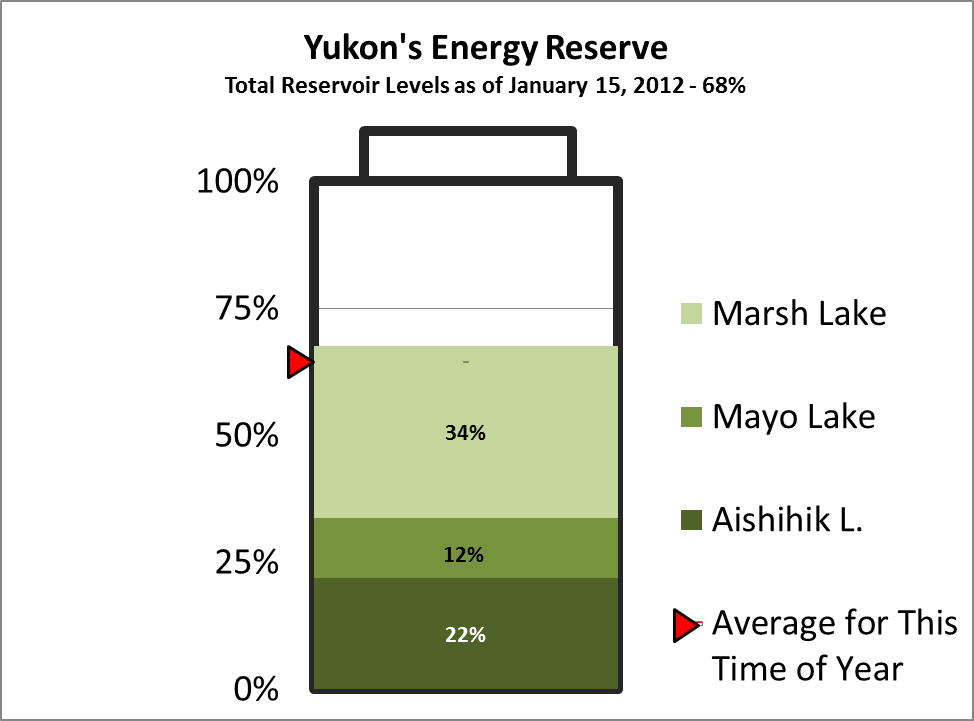
Yukon's Reservoir Levels - mid-January Update
The Yukon's Energy Battery just got bigger! - Yukon Energy mentioned that their Mayo-B and Aishihik 3 turbines are now running, so now the stored water will go further, making more energy.
As of mid-January, the energy stored in the reservoirs is about 68% full, about 4% more energy that on average for this time of year. I wonder how fast it will be used over the next two weeks as it has been so cold?
Subscribe to:
Posts (Atom)