Showing posts with label Energy Security. Show all posts

Saturday, October 12, 2019

How can Yukon Government Support Cycling in Whitehorse


I was recently asked what role Yukon Government (YG) has in developing cycling as a mainstream mode of transportation within the City of Whitehorse?

Most of the roads and trails within Whitehorse are the City’s responsibility, but Yukon Government plays a role in enhancing cycling in at least 6 areas:
  1. There will be a forthcoming Climate Change, Energy and Green Economy Strategy that is to replace the existing separate Climate, Energy and Biomass Strategies.  This new Strategy should set overall direction for government to increase support for sustainable transportation.  One aspect for this could be subsidies for electric vehicles.  I hope this includes full subsidy for e-bikes as the GHG reductions for an e-bike is FAR higher than an electric car.
  2. Updating the Motor Vehicles Act to become a more inclusive Road Safety Act (as per the resolution passed by the Association of Yukon Communities in 2019).  This should include several measures and changes that make cycling safer and reduce barriers to convenient cycling. Whitehorse Urban Cycling Coalition provided input into the Motor Vehicle Re-write and we look forward to all of that input being reflected in the new act.
  3. YG provides funding for projects, either directly from its resources, or through bilateral funding.  The bilateral funding is Federal money that flows to the Yukon Government which then in turn is used to fund municipal infrastructure projects.  This includes both Gas Tax and more significantly, funding from the Investing in Canada Infrastructure Program.  This latter is moving so much money to the Yukon that the municipalities cannot spend it all.  In the words of the municipal mangers “[capital] money is not the limitation; it is our capacity to manage the projects that is the barrier.”  Thus, YG plays a key gatekeeper role to funding municipal infrastructure projects.
  4. The Alaska Highway is a key transportation corridor that slices through Whitehorse and it is owned and managed by Yukon Government.  It is used daily by citizens to move about Whitehorse and as such is a major opportunity, or as seen recently, barrier to cycling.  The Alaska Highway acts as a major barrier or wall segregating Whitehorse in two halves.  But, since YG controls this land, they can build infrastructure that promote safe, convenient cycling connections both across the highway and along it.
  5. Schools are a major destination for cyclists in Whitehorse (many, being underage, do not have the privilege of operating a motor vehicle).  Department of Education has the resources and responsibility to provide safe routes to school. They can enhance connectivity on-school property to the cycle network.  Furthermore, they could invest in active transportation routes & connections to the schools.  Kids who arrive at school by active transportation (cycling or walking) are known to have better education outcomes.
  6. Lastly, YG is the largest employer in downtown Whitehorse.  They own and operate many workplaces, and like schools, can facilitate active transportation to those workplaces.  This would include both onsite infrastructures to support cycling such as high quality, covered, secure bike parking, workplace showers/change rooms as well as physical, convenient connectivity to the adjacent bike network.  These measures would help make cycling to work easier and more convenient, thus reducing barriers to cycle commuting. 
The more Yukon Government supports cycling through the measures above, it improves cycling for EVERYONE through the force multiplier effect.  Yukon Government just declared a “Climate Emergency” this week and here is a tangible way to put that declaration in action, save money and help build a healthier, happier community.


Wednesday, September 13, 2017

An idea to help balance Yukon's books: Stop subsidizing oil and gas.

The current Yukon Government realized they are going to be facing a $40-$60million shortfall (deficit) starting in 2018.  So they convened the Financial Advisory Panel to think up what to do.  This group did some online consultation this summer, which I did not hear about and missed the opportunity to provide input on.  Now they are doing consultation in the communities and an online survey (see https://yukonplans.ca/)

Here is my suggestion to help address this deficit:  stop subsidizing the use of oil and gas (propane).  This post is a bit of a work in progress as I mull through this idea, but I thought I’d get the idea out there now and update/revise this post as I think the matter through further.   If this topic piques your interests, please check back and I’ll provide more specifics.  

Based on my breakfast-table estimates this morning, I figure Yukon Government foregoes somewhere between $10million and $20million per year in revenues by subsidizing consumption of fossil fuels.  The perversity of these subsidies are:
  1. Yukon produces no oil or gas, so there are no benefits flowing to Yukon from these subsidies (increasing oil and gas consumption does not benefit our economy); 
  2. almost every dollar spent on oil and gas is a direct loss to the Yukon economy (all of those dollars are economic leakage and leave the Yukon); and 
  3. for most of the uses, we have made-in-Yukon cleaner, safer alternatives and solutions that would keep the money in the Yukon.
The Yukon subsidizes fuel usage in two ways:  firstly, Yukon has the lowest tax rate on gasoline in the Canada at $0.062/L. This is less than HALF the rate changed in any Province (lowest is Alberta at $0.13/L.)   That alone is worth $4million a year on tax revenue!  Secondly, Yukon offers tax exceptions on burning oil and propane for heating.  That means NO tax charged on these hazardous materials that are costing us a lot (for example spill cleanups, leaky tanks, heath-care costs, deaths by carbon monoxide poisoning, etc.).   Tax exceptions (which are subsidies) are also issued for commercial use such as mining.  Sure, there may be industries that we want to help support, but giving them a subsidy for how much fuel they burn is crazy.  Wouldn’t it be much better to give those vulnerable industries direct support that is in someway inversely proportional to their success?  These total tax breaks, based on the current tax rate of $0.072/L for diesel (which is what heating oil) is worth about $6million a year.  

I have a lot more specifics and details on this which I hope to write up and post here, but this is the gist of the idea now.  If you think this idea has merit and it seems wrong to your for government to raise your income taxes or cut service, but continue to subsidize burning of these dangerous and polluting substances, then please go to https://yukonplans.ca/ and complete the survey.  Participate in the public meetings if you can.

The Details:

Current Fuel Taxes


Saturday, October 8, 2016

Why a Carbon Tax is good for the Yukon’s economy


I’ve been really confused by the Yukon Party’s opposition to the carbon tax.  It seems they don’t understand the Yukon’s economy.  It needs to be said that in fact a carbon tax will be GOOD for the Yukon’s economy.  This is for two reasons:


1. The productive part of the Yukon’s economy actually has a very low carbon intensity.  We have a highly educated workforce and most of our economy is not resource intensive.  Mining, oil & gas are only about 13% of Yukon’s GDP (see Yukon Bureau of Statistics’ Gross Domestic Product (GDP) by Industry 2014).  Because mining produces a product (metal), that actually overstates the value of the resource industry when it comes to jobs and salaries paid.  Therefore the bulk of our economy is low-carbon intensity.  With a carbon tax, the Yukon’s economy is more competitive relative to carbon-intense economies.  In other words, the Yukon will perform better relative to other provinces when carbon taxes come into play.  This is a basic of economics:  do what you are good at and the Yukon is good at having a low-carbon intensity economy.

The Yukon also has excellent opportunity to further de-carbonize our economy by increasingly switching to renewable energy (primarily hydropower, but also biomass and to a lesser extent wind and solar).  Other jurisdictions do no have the natural resources to produce renewable energy that the Yukon does.  As such, the Yukon can readily further reduce its exposure to carbon taxes and become even more competitive.  

2.       Use of fossil fuels represents a significant economic leakage for the Yukon.  In 2013 the Yukon consumed about 226 million litres of gas, diesel (inc. heating fuel and jet fuel) and propane (see Yukon Greenhouse Gas Emissions: the Transportation Sector, 2015).  If we assume this is about $1/L, that is $226,000,000 that left the Yukon with just about no economic benefit to the Yukon (we essentially burned that money).  Any reduction in fuel usage will result in more money staying in the Yukon’s economy and can be put to more production use.  For example, the money could be used by Yukoners for arts, entertainment, culture, health care, education or just about anything will be more useful that burning the money.  This will also help build the local economy since more resources will be used and consumed locally.  Even a 10% reduction in fuel usage will be $22 million dollars that would be repatriated to the Yukon’s economy.  That is almost exactly at 1% increase in our GDP which would have wiped out the GPD decline the Yukon experienced in 2013 and 2014.  


Another thing that makes me mad is the rhetoric does not reflect the realities of math.  The carbon tax will have almost no measurable impact on the price of goods (and zero impact of the cost of services) because the amount of fuel used to transport goods to the Yukon is very very small relative to the value of the goods.  Where you will see the difference is at the gas pump and on heating fuel.  But it is not much of a difference:  the $10/tonne tax will be about $0.02 /L at the pump.  Yup, that is it: less than the price difference between gas stations and less than the difference between regular and premium.  If you drive the speed limit and drive conservatively, you will increase your fuel economy by 10% which more than offsets the fuel price increase of 1.7%.  Any driver can fully mitigate the any fuel price increase. 

Thursday, April 2, 2015

This heat pump Goes Up to Eleven

EnergyGuide label on the mini-split heat pump installed to heat our new Super GreenHome.  It goes up to eleven!  Note that the efficiency scale bar on the bottom of the tag only goes up to 10.2.


This is a Fujitsu Extra Low-Temperature Heating mini-split air-to-air heat pump.  The manufacture claims it operates down to -26oC.  We've had it installed for only a month now, but we did have a -25oC morning.  I went out to check and it was purring away making heat.

More pictures to come...

Tuesday, August 26, 2014

Lots and lots of Sprayfoam

Yesterday they started sprayfoaming our little laneway house.  Although sprayfoam is often used in certain applications as part of house construction, the unusual thing about this house is we are using a whopping 7.5" of closed-cell sprayfoam, installed on the outside of the building.  This acts as a big blanket that completely envelops the house.  Green Building Advisor calls sprayfoam the "King of Insulation".

First layer of closed-cell sprayfoam being installed.  All finished trim and windows have been masked-off to protect from over-spray.

Closed-cell foam has an R-value of 6 of 6.5 per inch.  This means the sprayfoam provides at least R45 on the outside of the house, plus it acts as our air barrier and vapour barriers.  


The closed-cell foam has to be built up in layers.  I looks like they can put on about 2" to 3" of foam each pass, so it will take them a few days to completely fill the 8" cavity.

Today while I was watching the contractor work (the job is so big the they actually using TWO sprayfoam rigs at the same time to do the job), I was thinking it seems a bit crazy to put on this much insulation because it is a lot of work (and cost).  But then I realized it is like pre-buying all of my fuel / energy now.  By superinsulating the house, I've built in keeping the house warm now, at the outset.  I won't have to buy a bunch of energy for the remainder of the life of the building because all of the insulation reduces the heating needs of this home by 90% over a conventional home.

The sprayfoam contractor is Energy North Construction and so far they seem to be doing a good job.  They've been pleasant to deal with, accommodating and responsive.  This job is unusual, but they were keen to tackle it.  

As bonus content, here is a little video of dancing sprayfoam guy:


Thursday, October 10, 2013

A tour of cycling infrastructure in Toronto

I've been in Toronto to see family and run in the Canadian orienteering championships in Hamilton this week.  Weather has been very nice, and so I decided to dig out my father in-law's bike which was abandoned in his basement and go for a ride (unfortunately, I didn't take my camera, so all of these pictures are shamelessly stolen from the internet).

I had a copy of the new Toronto cycling map and decided to take a route so I could check out the new "Cycle Track" on Sherbourne Street. I'll describe it a bit later on, but for those not familiar with it, a cycle track is a type of "bike lane"  that is somehow physically separated from the roadway.   It might be the premier type of bike infrastructure because it is fast and direct like a bike lane, but provides cyclists extra security and comfort by separating the bike lane from the car lane.  I noticed that when I was in Sweden this summer that this is the most common type of bike infrastructure there, even in the far north winter cities we visited.

Raised cycle track on Sherbourne Street, Toronto

Anyway, back to my route.  The first thing the struck me is the random, disconnected nature of the bike infrastructure - take a look at this map, do you see any logical routes or connectivity? 

Section of Toronto Cycling Map - random bits of bike infrastructure, not connected nor logical routes.  Blue lines are simply "recommended" streets to use and don't represent bike lanes or other infra.

Diminutive bike route signs
I started by following some of the blue routes, which are "shared roadways" that are supposed to be signed, on-street routes.  Well, there is signage, but it is tiny, and has route numbers on them that don't mean much to me.  Where does "18" lead me to?   Then the route was terrible, every intersection had stop signs, so no flow, stopping always - why could they have not just turned the signs?  And it was on rough, neglected streets!  I got lost a couple of times and had to check my map.  A one spot I even ended up on Bayview Extension (not a bike friendly place), looking up at a pedestrian overpass with on clue how to get up there.  A cyclists yelled down to me directions on how to get off the expressway and find the bridge!

Now, at this point I was pretty disappointed with how terrible cycling in Toronto is.  But then, I thought back to when I lived here in 2001, and back then there was NO bike maps, NO bike infrastructure, so I guess they actually have come a long way.  But, definitely the Car rules in Toronto.

Finally I made it to the Sherborne cycle track.  It runs north-south pretty much the length of downtown - so you can traverse downtown on separated bike route, which is quite nice (I've circled in in red on the map):

Sherbourne Street cycle track running the length of downtown north-south.

 It is pretty nice - fast and comfortable.   I found a little YouTube video of the track; it is of the upper part of the track which has a divider between the roadway and the cycle lane:


The upper section of the cycle track uses a low barrier to separate the roadway from the bike lane.

Cycle track with barrier type separation.

I don't know how well this would work in a winter city from a plowing perspective as it would have to be plowed separately, which is in fact what they do:
Plowing of Toronto cycle track

Raised cycle track with low roll-over curb.
Lower down on Sherbourne, the cycle track changes to a raised cycle track that is separated from the roadway with a low roll-over curb (shown below and as first picture above).  This type of track I think would work very well in Whitehorse because it could be plowed from the roadway with a wing-plow on the grader, but would keep all the road debris and snow-berm from the roadway out of the cycle lane.  If you look at the newly build Industrial Road, it has this type of low roll-over curb, so I know we can build them in Whitehorse!

Another thing I noticed was the abundant use of markings (paint/thermoplastic, etc), which  I'm always suspect of because in Whitehorse it always gets worn off in the winter.  But, then I remember that in low-traffic streets, the paint on our streets does last a long time.  I think we just lose the paint where there is a lot of motor vehicle traffic that tears the paint off when the streets are sanded.  So now that I think about it, I think the paint on a cycle track in Whitehorse would last pretty well.


Another neat thing was how the bus stops are integrated with the cycle track.  The track rises up so there is a good curb at the bus stop (there is also a good view of it at 0:35 in the video above):


After my fun ride down the cycle track, I then proceeded to get lost in the mayhem of downtown Toronto.  I think the car congestion in Toronto is worse than I ever remember it.  All the more reason this city needs to spend on getting people out of their cars.  

The rest of my ride was back to ratty old bike multi-use bike trails/paths up the Don Valley.  The trails are badly neglected, lots of pot holes, twisty and convoluted routes that go through parking lots, use road ways, etc.

I did get to ride along a new cycle path (two way) along Queen Quay which looks like is just getting finished and is obviously incomplete with a few gaps - it is a two-way shared pathway with laneway markings.  I didn't find any good pictures, but here is one earlier on in its construction:

http://www.ibiketo.ca/taxonomy/term/21?page=1
This trail/bikeway was nice, but the curbs at each driveway were very rough, so it made riding it a bit unpleasant.  Too bad, it would have been an easy thing to build t the curb cuts smooth so you could have a better ride. 

Anyway, the weather was amazingly nice for first week of October and so it was great to get out for a sunny, warm bike ride.

Tuesday, September 24, 2013

My best footnote ever: single handedly demolishing the Yukon's GDP!

Below is a screen shot from the little Yukon greenhouse gas emissions analysis report (Yukon Greenhouse Gas Emissions:  the Transportation Sector) Malcolm and I did last year for Climate Change Secretariat.  For those data and economics nerds, this little footnote is cool:  we just knocked  $156 million dollars out of the Yukon's 2011 economy.  BAM!  Take that economic impact Darrell.


Monday, April 1, 2013

Why Whitehorse Sucks Reason #8* - Sprawl

My brother recently moved to the far side of Riverdale.  I was biking over there the other night from my house downtown, and I was thinking "My god, this is a far.  Why did he have to move so far away?"

This got me thinking about the winters we lived down in Portland Oregon, and I didn't think it seemed that far to bike places.  So, I decided to do some checking.  Straight line distance from my place to the far side of Riverdale is 3.2 km.  Below is a 3.2 km radius circle from my house.  You an see how much of Whitehorse is encompassed.


By comparison, the second picture shows the same 3.2km radius circle centered on the house we rented in one of the nice old streetcar neighborhoods in Portland. I was shocked:  3.2 km took us full across the entire downtown core of Portland.  Not only does this circle encompass the downtown core, it includes many of the interesting trendy neighborhoods, several of the charming bungalow neighborhoods and even seven bridges over the river!  A majority of our tourism time in Portland was all contained in this 3.2 km circle. I can't believe how much of the community was in such a compact area - no wonder Portland is such a great bike town. And no wonder that Whitehorse sucks for biking--there are too many blank spaces and low-density sprawl. 


Now, I'm not complaining about the amount of awesome wild land in Whitehorse that I have direct access to in that 3.2km circle, but I definitely see we are wasting the space we are using.  I see we can have both.  If we made better use of the developed land (and the wastelands between), easily doubled up the density, then we would have a much more vibrant, interesting and livable community, and still have the real green space immediately accessible too.


* I haven't settled on the other nine reasons why Whitehorse sucks, but I'm sure I will eventually come up with them!  

Monday, November 12, 2012

Designing Homes for Passive Survivability

Superstorm Sandy me reminded me about the idea of "Passive Survivability" in building design.  And then I noticed an article in www.greenbuildingadvisor.com on building for resilience called "Gas Lines Point to Need for Resilience" - a good read, check it out.

Passive Survivability is the idea that in the case of disaster (power outage, short or long, earthquake, etc.) that your home is inhabitable, protecting and sheltering you in difficult times.

In designing homes for the Yukon, there are a number of very simple strategies that can and should be incorporated to generate "Passive Survivability" in your home:

1. Design and build the home that is likely to physically survive the disaster, such as flood, fire and/or earthquake:
  • Flood is obvious - don't build on a floodplain or low down, next to water!  
  • Fire, especially wildfire, is pretty well understood by Yukoners and I don't need to cover reducing and managing fire risk at your home as that is well addressed elsewhere.  However, do think about cement board siding (e.g. HardiePlank or equivalent).  Ever seen vinyl siding when it gets "warm" - scary! 

  • Homebuilders' Guide to Earthquake-Resistant Design and Construction
    Earthquake resistant design is recommended.  Earthquakes are a threat in southern Yukon, so we should include design and construction elements to our buildings to give them a better chance of surviving "a big one" when we get hit.  The US Federal Emergency Management Agency (FEMA) has an excellent document for home builders called Homebuilders' Guide to Earthquake-Resistant Design and Construction.  It is very practical and has lots of good things that are very easy and inexpensive to do in the design and construction of a home that is going to make it much more likely to survive an earthquake.  Whitehorse is probably in a Seismic Design Class (SDC) of C or D1, which means that earthquake resistance measure really should be incorporated.  We did this in the SuperGreen duplex build in Takhini North, and it was very easy to do - just need to pay attention to the details.

Example of superinsulated wall.  Note wall thickness shown by double-doors
 2. Superinsulated building - so when the power goes out, the building stays warm. Seems obvious--put lots of blankets on your home so you stay warm for a long time.

By superinsulated, we mean EnerGuide 85 - so using half the heating requirements of a conventional new home in Whitehorse.  R60 walls, R100 ceiling, best windows you can get, and a very air-tight building envelope, etc.  We've covered the super insulation thing enough here on this blog, so no need to say more.


3. Wood heat - consider including a wood stove in your home.  Again, when the power goes out, a wood stove is the only off-the-shelf heating system that will easily work without power.

Also, think about using a propane cook stove & oven.  You can light them and cook even when the power is out. 

WARNING - use of a propane cookstove indoors without adequate ventilation presents a health hazard.  So when the power goes out, make sure you provide adequate ventilation by opening windows because you mechanical ventilation (rangehood and HRV) won't be working!

At minimum, have a barbeque and an extra tank of propane.  

Extra-large hot water tank can provide water in emergencies
4. Oversized hotwater tank - If the power and water goes out, you have lots of water stored in that tank.  Make sure the drain is accessible of course.  Another good reason that on-demand hot water heaters don't make sense in the Yukon.  Don't worry about the standby losses from the hot water tank.  You need the heat in the home at least three-quarters of the year, and with a superinsulated envelope, you are not wasting any energy.

In the photo to the right, there is one thing missing though - seismic tie-downs on the tank!  You don't want to loose your precious water in the case of a large earthquake by your tank tipping over.


Windows at each stairway landing for light
5. Windows in all rooms to provide natural light, especially windows in stairways.  If you have windows to provide even some natural light to all rooms in the house, then when the power goes out, you will still be able to move around.  Locating your stairs so you can have windows is an important design consideration so you can get out of the house in the dark.


Infloor heating tubes layed out ready for basement concrete slab
6. Think about installing in-floor heating in the basement floor concrete slab for thermal storage.  If you are pouring an insulated, concrete slab for the basement add in-floor heating tubes to use the basement to not only provide comfortable heating to the basement, but also "thermal storage" in the case of power/heat outage.  The bulk of the cost for this is the concrete floor, which you are pouring anyway, so adding the tubing is a small incremental cost for a "heat-insurance" plan.

With a super-insulated home, a heated up slab can keep the house warm for days even during the coldest weather as the slab radiates the heat stored up in the slab.  We figured this out first hand accidentally.  I inadvertently turned off our heating system one winter (it was -35C at the time) and it was for a couple of days until we realized the heat was off! 


Tuesday, November 6, 2012

Updated Home Heating Energy Graphs


With winter and heating season on us, the good folks over at Yukon Housing Corp have updated the their home heating energy cost graphs. Check them out at:


People are always asking "what is the cheapest way to heat my home" - these graphs give the up-to-date answer. It is important to watch these trends, because things are always changing. What we "knew" about home heating 5 years ago no longer holds true - so keep you eye on our energy cost trends! These graphs show the all-in cost of energy, including the efficiency of the appliance that give you the actual heat delivered, allowing you to compare apples-to-apples. Probably the most useful two graphs for Whitehorse homeowners is graph #1 - Home Heating Costs vs. Heating Appliance Efficiency. The other one to check out is graph #13 - Whitehorse Historical Residential Heating Costs at 80% Fuel Use Efficiency . This latter one is important because it show energy cost trends we've actually experienced over the last 10 years.

What are some key observations?

· Pellet prices have been steadily rising. If you have a low efficiency pellet stove, it could actually be more expensive than electricity.

· Oil and propane remain the highest cost option, especially if you have a low- efficiency furnace- even with the increase in electrical rates.

· Propane costs have dropped a lot lately and now are similar in energy cost to both oil and 2nd block electricity (Propane used to be the most expensive option).

· Overall, oil fuel prices have tripled since 2000 and continue to show high price volatility.

· We've moved to the 3-tier electrical pricing and electricity costs have jumped slightly, although still remain the lowest cost energy, especially first block energy. Remember you get the first 1,000 kWh at the low rate, then everything above that is higher. I think most people if using electric heat will definitely go into the second block, but won't be using a lot at the top rate.

· Another interesting thing is to look at the energy costs, particularly electricity and propane, that other customer classes pay (government for example) are vastly different that what we pay as home owners. Look at propane - the government is only paying $0.38 / L where homeowners are paying $0.84 / L - wow, that's a big difference!

Monday, April 16, 2012

One Year in a SuperGreen Home

We've now got a whole year's worth of energy usage data from the SuperGreen duplex.  And the results confirm what the earlier trends showed - this home is using even less energy than predicted, about 30% less!
Results are shown for 38 Nijmegan below (special thanks to the owners for sharing the energy usage data).  We also have almost a full year from 40 Nijmegan, the other half of the duplex.  And it shows the same trends - about 30% less energy usage.  So this tells us it is not just a fluke or entirely occupant behaviour--in fact the buildings are performing consistently better and anticipated.  

The graphs below shows predicted energy usage (shown as bars) versus the actual total energy usage in the duplex (shown as a green line) for the months for a whole year.  The red line show is the energy usage of a similarly sized conventional new home in Whitehorse.  Actually energy usage has been "normalized" to take of the fact that much of this year's winter was pretty warm.  So this is adjusted to average weather conditions.


SuperGreen Energy Usage Versus a Conventional Home
For comparison purposes (and to help illustrated the predicted versus actual energy performance of the building) the energy usage of a similarly sized, new home in Whitehorse is shown on the graph as the red line.  This represents an electrically heated new home built in compliance with the City of Whitehorse’s energy efficiency bylaw.  By way of comparison, over the year, total energy costs for the conventional, electrically  home would have been $3,920.  The actual energy costs over the same period for the SuperGreen duplex have only been $1,390.  That is less than half the energy cost – a savings of $2,530 in just one year!

Tuesday, December 6, 2011

Yukon's Reservoir Levels - December 1st Update

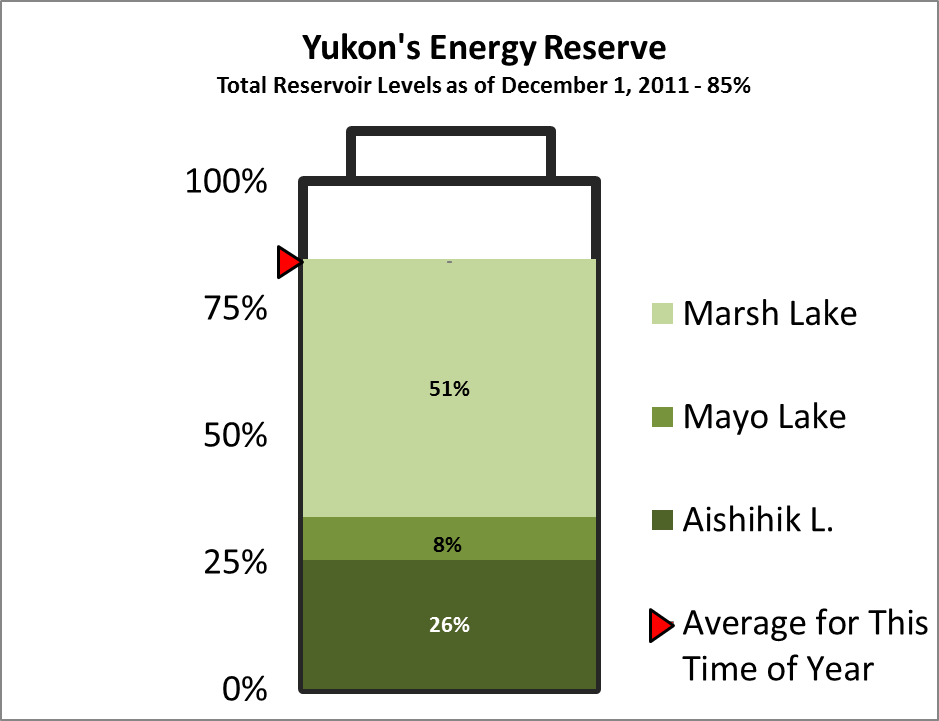
The energy storage is dropping fast - we used 5% of our stored water in two weeks and we're now down to 85%.  This is actually about average for this time of year, but I guess November was a cold month so we used a lot of energy.  Aishihik is fuller than normal, but Marsh Lake is coming down fast

Thursday, November 3, 2011

Yukon's Reservoir Levels - November 1 Update

The reservoirs are still pretty full at 96%, about 6% more than normal.  I suspect we are ahead of normal because Aishihik and Mayo were shut down for their upgrades, which kept those reservoirs topped up.